
Blog
Bob Weir’s Influence on the Grateful Dead: Rhythm Guitar, Legacy, and Musical Innovation
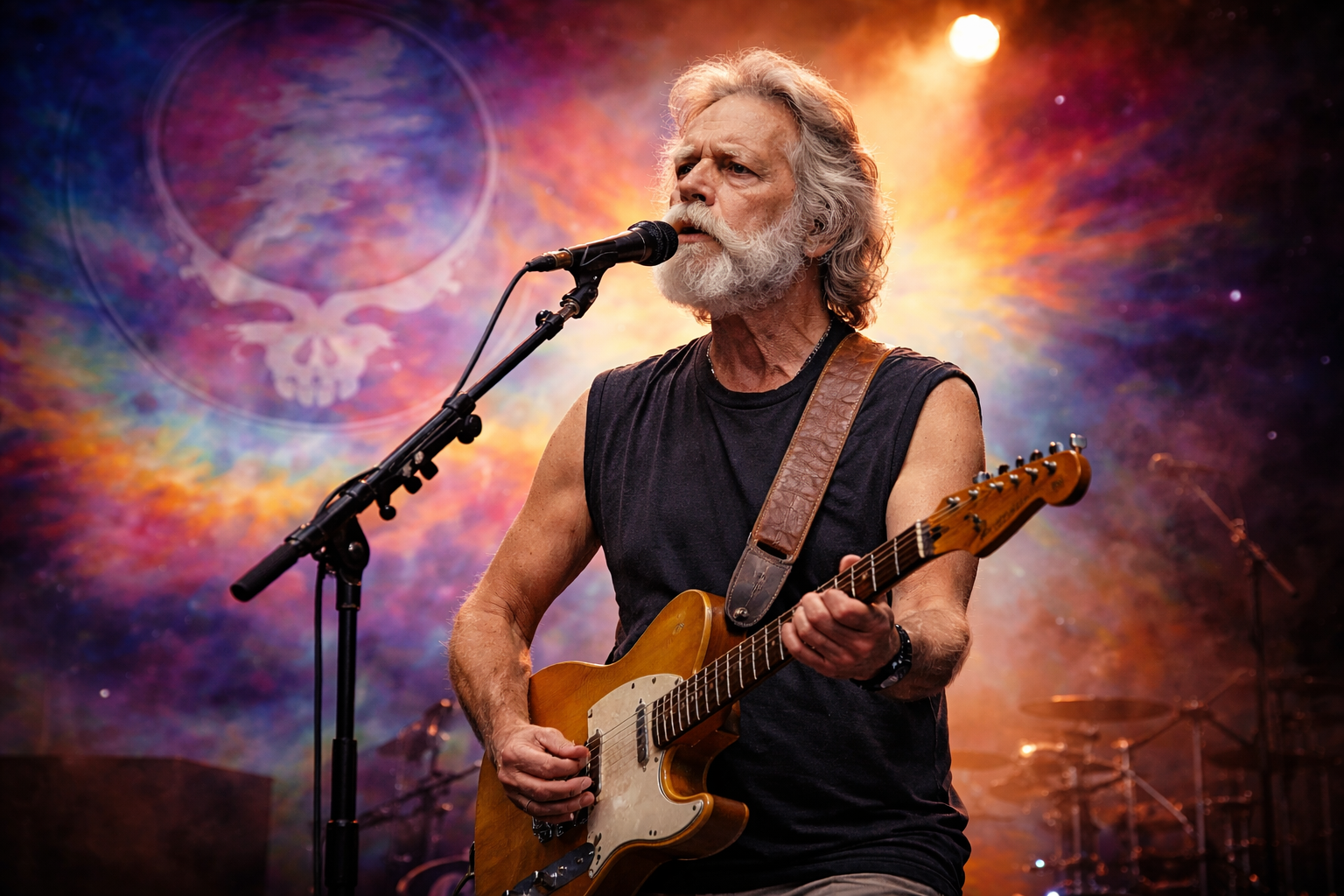
ARTICLE SUMMARY: Bob Weir was not just the Grateful Dead’s rhythm guitarist. He was the structural architect of the band’s improvisational sound, shaping momentum and cohesion through unconventional chord voicings, syncopated rhythms, and deep ensemble awareness. After Jerry Garcia’s death in 1995, Weir became the steward of the Dead’s living tradition through projects like RatDog, Furthur, and Dead & Company, mentoring newer players and keeping the music evolving without turning it into nostalgia. His quiet leadership and rhythmic intelligence built the foundation that made the Dead’s freedom possible.
Bob Weir: Sage & Spirit – Playing the Long Game
Section 1: Playing in the Band — The Misunderstanding
For decades, I was a Jerry fan. The allure was immediate, visceral, almost unfair: Garcia’s guitar was fluid, unbounded, effortlessly melodic; a magnet drawing you into the music in a way that made everything else seem incidental. Rhythm guitar was background, harmonies were footnotes, and Bob Weir, at first, was a foot soldier in a parade led by genius. I loved the Grateful Dead, but my ears were trained to chase the sparks, the peaks, the improvisational fireworks that seemed to spring exclusively from Garcia’s hands.
Hidden in the Negative Space
Bob Weir existed in that space just beyond notice. His voice was distinctive but understated; his chords and rhythms idiosyncratic, but easy to dismiss if you were following the solos. Early on, he seemed peripheral, a structural constant rather than a source of revelation. Yet there was something quietly magnetic about the way he moved through the music, a subtle logic in the chaos I simply wasn’t attuned to. I didn’t know what I was missing, not for years.
The Architecture Beneath the Chaos
I first noticed Bob not in the grand peaks, but in the spaces Garcia left behind. A jam would stretch for twenty minutes, swirling in improvisational madness, and beneath it all, a subtle rhythmic architecture kept the chaos coherent. A chord here, a pause there; he was shaping the jam from the inside out. At the time, I assumed it was incidental, a technical measure to keep the band from derailing. Only later would I understand that those rhythms, those touchstones, were the music itself, and that Bob Weir had been silently orchestrating it all along.
What fascinated me was how instability could feel intentional; how music could teeter, stretch, even threaten to come apart, yet remain communal and forward-moving. There was a sense of motion without destination, a collective willingness to stay inside uncertainty rather than resolve it. Bob didn’t announce control; he implied it, allowing the music to test its own limits while quietly defining how far it could go.
The Quiet Architect Revealed
Over time, I came to understand where Bob Weir’s style actually came from. His playing carried traces of folk fingerpicking traditions like Merle Travis, the harmonic intuition of Charlie Christian, and the syncopation and groove of folk and R&B. Those elements fused into an approach that privileged ensemble cohesion over soloistic display; a philosophy that put him in quiet tension with the very culture many of us were trained to admire. The Grateful Dead were associated with improvisation, transcendental peaks, and front-and-center spectacle, and Bob’s genius was easy to miss if you listened only for the apex of those moments. His work lived elsewhere: in structure, in momentum, in the spaces that made those peaks possible.
The culture of Dead fandom trained listeners to chase peak moments, to exalt improvisational genius, to equate significance with volume, distortion, or emotional outburst. Bob’s gift was quieter, less conspicuous, but no less vital. He was the heartbeat, the subtle architect, the stabilizing force that made Garcia’s high-wire acts possible. And in the decades that followed, especially after 1995, it became clear that Bob Weir was not “the other one.” He was the one: the figure who held it all together and carried the music forward, intact, into the next generation.
Section 2: Jack Straw — The Band as System, Not Myth
The Grateful Dead was never just a band. In its earliest days, it was a living, breathing experiment; an ecosystem more than a group of musicians. The Warlocks, as they were briefly called in 1965, were a ragtag assembly of friends and visionaries: Jerry Garcia, Bob Weir, Phil Lesh, Bill Kreutzmann, and Ron “Pigpen” McKernan. San Francisco in the mid-’60s was itself a laboratory, a city in flux, a countercultural petri dish where folk, jazz, R&B, and nascent psychedelia collided in the same clubs and living rooms. Into this mix, Bob Weir brought a sensibility that was both musical and organizational: a sense of internal logic, a rhythmic intelligence, a capacity to hold improvisation together without ever seeking the spotlight.
An Ecosystem, Not a Spotlight
I wasn’t there in the Haight-Ashbury haze, and neither were most of those whose fandom would later define the Dead. Yet in retrospect, the tension of those formative years is palpable. The band’s early trajectory was marked by experimentation and instability: musicians learning how to stretch a song into a twenty-minute exploration, guided less by conventional structure than by instinct, peer intuition, and the mercurial chemistry of very different personalities. Jerry was the gravitational center, drawing attention with fluid leads. Pigpen supplied earthy, visceral energy. Phil and Bill were the engine room. And Bob occupied a less visible role, quietly shaping how all of those forces interacted. The music functioned not as a collection of individual statements, but as a network of interdependence; each part responding to the others in real time.
Some of the early dramatic moments of the Dead’s history helped define both the music and the mythology. The Acid Tests in 1966–67 were not just parties; they were experiments in collective perception, a fusion of light, sound, and psychedelic experience that challenged the very definition of performance. In those volatile environments, coherence mattered. Bob’s role, though subtle, was critical: his chord voicings, timing, and attention to ensemble balance allowed the band to navigate unpredictability without losing collective momentum. In the midst of swirling chaos, he provided a rhythmic center that the audience couldn’t see but could feel, and that the musicians themselves relied on more than they often realized.
The Quiet Labor of Cohesion
What emerged from these years was a model of music-making that resisted hierarchy. Songs were not vehicles for solos so much as frameworks for interaction. Momentum mattered as much as melody. Continuity mattered as much as brilliance. Bob’s playing reflected that ethos: he threaded harmonic cues, pauses, and rhythmic punctuation into the music, guiding movement without asserting dominance. The result was improvisation that felt communal rather than competitive; freedom bounded not by rules, but by mutual awareness.
History, in retrospect, reads like a series of near-disasters and improbable survivals. Pigpen’s early death, shifting lineups, relentless touring, and the logistical strain of sustaining a countercultural experiment made the band’s longevity far from guaranteed. Yet Bob’s contributions remained constant. He was the stabilizer in a group defined by risk; the rhythmic intelligence that allowed improvisation to breathe without collapsing; the player who could turn a simple narrative song into a fully inhabited world through timing, restraint, and placement alone. His gift was subtle, often overlooked by fans chasing climactic moments, but essential to the band’s identity and resilience.
Listening back with this perspective changes the story. The Dead could have been a series of dazzling peaks or loosely connected jams. Instead, they functioned as a system; adaptive, responsive, and deeply interdependent. Understanding Bob Weir requires listening for that system at work: the quiet labor of cohesion, the discipline beneath apparent looseness, the intelligence that allows a sprawling organism to hold together over time. Only through that lens does the music’s genius become fully legible, and only then can what followed, especially after rupture and loss, be understood as something more than momentum or nostalgia.
Section 3: Cassidy — Hidden in Plain Sight (1965–1979)
For most of my early life as a Grateful Dead fan, Bob Weir barely registered as an object of focus. That wasn’t because he was absent; it was because he was everywhere. Jerry Garcia was the sun around which everything seemed to orbit. Melodic brilliance, emotional immediacy, the sense that the truth of the band lived in the lead line. Jerry was where you looked if you wanted transcendence. Bob was what you heard only if you learned how to listen sideways.
This wasn’t accidental. The Dead trained their audience to chase peaks. Tapes traded hand to hand were cataloged by jams, by crescendos, by moments when the music appeared to lift off the ground. Garcia’s playing rewarded that kind of listening. Weir’s did not. His work was cumulative, structural, resistant to highlight reels. He played parts that only made sense over time, across entire performances, entire tours, sometimes entire decades.
Learning to Listen Sideways
In the band’s early years, Bob was still learning how to be Bob Weir. Famously dismissed and rehired in 1968 for a perceived lack of commitment and technical skill, he returned transformed: disciplined, inquisitive, increasingly uninterested in traditional rhythm guitar roles. What followed was one of the most idiosyncratic evolutions in rock history. Rather than strumming chords or anchoring harmony predictably, Weir began to fracture rhythm itself: dropping expected downbeats, introducing irregular voicings, and treating the guitar not as accompaniment, but as an active, unpredictable force within the music.
This emerging language is evident in songs like The Other One, where relentless syncopated figures drive the band even as the music dissolves into abstraction, and Playing in the Band, built on an odd time signature and elastic structure that forced the group into unfamiliar terrain night after night. This wasn’t Jerry stretching outward from melody; this was Bob pulling the entire ensemble sideways, insisting they inhabit instability and discover new spaces together.
Weir’s covers told a similar story. Me and My Uncle, El Paso, Big River; these weren’t throwaway cowboy tunes or crowd-pleasing palate cleansers. In Bob’s hands, they became narrative engines, grounding the band in American myth, while giving the improvisers something solid to push against. His sense of storytelling was rhythmic as much as it was lyrical. He knew when to rush a line, when to hang back, and when to let silence do the work. These songs weren’t about virtuosity; they were about control. They were about holding a room without dominating it.
Certain songs, even if overlooked in the broader canon, reveal his approach clearly. Their subtle harmonic gestures, meditative phrasing, and restrained dynamics reflect a philosophy of music as architecture: guiding, supporting, and shaping the ensemble without demanding attention. In these moments, Weir’s quiet intelligence is on display, the principles of his unique approach made audible without fanfare.
The Architecture Comes Into Focus
By the mid- to late-1970s, this approach had matured into something quietly radical. Listen to the band during this period; not for the solos, but for the negative space. Listen to how Estimated Prophet breathes, how its groove tilts and corrects itself in real time. Listen to Weather Report Suite unfurl like a living composition, its movements connecting like a larger suite; each gesture purposeful, each pause consequential. That’s Weir, negotiating constantly with Phil Lesh’s bass, nudging Garcia’s lines, leaving doors open rather than closing them with harmonic certainty. He played like someone who trusted the band more than the song, the process more than the product.
For a long time, I mistook that humility for limitation. I assumed Bob was simply less essential, less gifted, less central. But what I was really responding to was my own listening limitations; my expectation that importance announces itself loudly. Bob Weir never did. His work was designed to disappear into the whole, to be felt rather than seen.
Disappearance as Design
That disappearance was not passive. It was a choice. Weir was building a language that only made sense inside the Grateful Dead: a private syntax of rhythm, interruption, and suggestion. Outside the band, it could sound awkward or incomplete. Inside it, it was indispensable. Remove it, and the entire structure collapses. Bob wasn’t merely keeping time; he was designing the conditions under which time could bend.
By the end of the 1970s, the evidence was everywhere, hiding in plain sight. Bob had become the band’s internal compass; the player most invested in where the music could go, rather than where it had been. I just wasn’t ready to hear it yet. Like many fans, I was still chasing obvious miracles, unaware that the real lesson was unfolding quietly beneath them.
Understanding Bob Weir during this era requires patience, the same patience his playing demands. It requires letting go of the idea that greatness must announce itself and accepting that some of the most consequential work happens in the background, shaping outcomes without ever claiming credit. That realization would come much later for me, after loss reframed the music entirely. But the groundwork, the architecture, was already laid.
Section 4: Estimated Prophet — After the Center Falls (1995)
Jerry Garcia’s passing in 1995 was a rupture the Dead were not prepared for, although the writing had been on the wall for some time. For fans like me, it was a moment that reframed everything we thought we knew. The music didn’t just lose a lead guitarist; it lost a gravitational center, a figure around whom the entire experience had revolved. And yet, from that absence, a different perspective emerged. Bob Weir, once the quiet architect in the shadows, became impossible to overlook.
In the immediate aftermath, many feared the music itself might unravel. The improvisational spirit of the Dead seemed inseparable from Garcia’s presence; the band’s chemistry, honed over decades, was tied to his touch. But Bob, carrying the institutional memory and structural sensibility we had spent decades underappreciating, assumed the mantle of custodian. Through RatDog, Furthur, and eventually Dead & Company, he guided the music into a new era, preserving its improvisational core, mentoring a new generation of musicians, and creating a new generation of fans.
Bob’s voice, once easily missed in the swirl of live chaos, became the anchor. Songs like Deal, Bird Song, Morning Dew, and Eyes of the World were reshaped by his phrasing and rhythmic authority. Originals such as One More Saturday Night and Victim or the Crime took on renewed weight in his hands. Certain compositions, built on irregular pulse and elastic structure, might seem unsteady to the casual listener, but in Bob’s hands they become lessons in balance. He threads timing, restraint, and nuance through the music, guiding the band with quiet certainty, turning uncertainty into a living framework for improvisation.
Covers, too, were reborn: Dylan, Sutton, McKernan; every song became a platform for Bob’s interpretive vision. He wasn’t merely performing; he was remaking the canon from within, turning decades of improvisation into a living, teachable language.
The Custodian of the Framework
Watching this unfold was revelatory. For decades, I had chased peaks, dazzled by leads and crescendos, unaware of the framework beneath. Post-1995, I finally understood that the brilliance of the Dead was never just Jerry’s magic. It was the architecture: Bob’s rhythms, cues, and harmonics that made the magic coherent. The improvisational freedom I had idolized was only possible because Bob had always been there, quietly maintaining the foundation.
His mentorship of younger musicians was another critical aspect of this era. In a scene obsessed with technical prowess and historical authenticity, Bob’s teaching emphasized conversation over perfection, listening over dominance. Dead & Company shows, packed with fans both old and new, became forums where the music could breathe and evolve, guided by his subtle authority. Improvisation was no longer a gamble; it was a dialogue. And Bob was both moderator and participant, shaping interactions without asserting ego over the ensemble.
This period reframed my own listening. I went back to older shows, realizing for the first time that Bob’s genius had always been there, quietly threaded through every chord, every pause, every harmonic pivot. What once seemed peripheral; the rhythm guitar, the understated phrasing, the refusal to dominate, was the core. Bob Weir had become the center by default, not through overt display, but by proving indispensable in ways most fans only understood in hindsight.
By preserving the ethos of the Dead, Bob ensured the music would remain alive, dynamic, and relevant. The post-Garcia era was not a shadow of what came before; it was the realization of what had been there all along. The heartbeat that had quietly held the band together for decades became unmistakable, audible to anyone willing to listen, not just as supporting rhythm, but as the very force that made the Dead endure.
Section 5: Standing on the Moon — Musical Legacy and Innovation
Bob Weir’s influence on music is both structural and philosophical. While the world often measured greatness by flashy solos or charismatic lead lines, Bob’s contributions operated on a different axis: rhythm as invention, rhythm as architecture, rhythm as conversation.
He redefined what it meant to play rhythm guitar in a jam-band context, turning it from accompaniment into an engine of improvisation. Where others might use rhythm to support melody, Bob used it to shape the trajectory of a performance, guiding the band through unpredictability with subtle precision.
Rhythm as Architecture
Covers, a longstanding part of the Dead’s identity, were another area where Bob left an indelible mark. Tunes like Me and My Uncle, El Paso, Mama Tried, and Me & Bobby McGee became uniquely Bob moments, defined not by notes alone, but by phrasing, timing, and rhythmic nuance. In his hands, covers were not mere homage; they were vehicles for improvisation and narrative, core components of a living repertoire. Every performance became a dialogue: between musicians, between audience and band, and between the past and present of the music itself.
Original compositions further reveal Bob’s vision. The Other One, Playing in the Band, Estimated Prophet, Black Throated Wind, and Weather Report Suite show a mind attuned to structure and spontaneity alike. He was a composer who thought not only about melody and harmony, but about space, timing, and collective interaction. His songs demanded engagement from every band member, creating networks of rhythm and counterpoint that made long-form improvisation possible.
Nowhere is Bob’s sense of lift and aspiration more palpable than in his compositions and interpretations that seem to rise above the terrestrial. In performances like Looks Like Rain, Black Throated Wind, and later-era renditions of Morning Dew and Days Between, one hears a musician stretching music toward a higher vantage point, guiding it into conceptual space rather than emotional excess. The phrasing, the delicate tension between rhythm and melody, and the patience of his harmonic choices reveal his capacity to transform simple structures into something expansive, deliberate, and quietly cosmic. Here, Bob isn’t merely supporting the music; he is creating a gravitational field around it; holding the band in orbit while leaving room for improvisation to breathe.
Stewardship and Evolution
Bob’s innovation extended beyond composition and rhythm. In the post-Garcia era, he assumed the role of steward, guiding the music forward in a way that preserved its ethos, without freezing it in time. Dead & Company, RatDog, and Furthur were living laboratories for improvisation, experimentation, and mentorship. He guided younger musicians, preserved the improvisational ethos, and transformed decades of tradition into a framework that could evolve with new audiences.
Ultimately, Bob’s legacy is inseparable from the music itself. Every jam, every groove, every subtle cue bears his fingerprints. The freedom that fans have long celebrated in the Grateful Dead cannot exist without the structure he provided. Improvisation is only meaningful when it has a foundation, and the most radical creativity often lives in restraint. Bob’s musical philosophy points upward without ever insisting on control: elevation through patience, vision through balance, and a quiet brilliance that allows the extraordinary to unfold around him rather than through him.
Section 6: Throwing Stones — Bob Weir’s Enduring Influence
Bob Weir’s influence extends far beyond chords and improvisation. For fans, musicians, and collaborators alike, he was a teacher, a guide, and a touchstone. He approached music not as a performance to be mastered or a spotlight to be claimed, but as a conversation; one that requires patience, attention, and generosity. This ethos shaped not only the sound of the Dead, but the culture around it.
Mentorship as Philosophy
Throughout Dead & Company, RatDog, and Furthur, Bob mentored younger musicians, showing them that playing in the Dead tradition was less about technical virtuosity and more about listening: to each other, to the space between notes, and to the collective energy of a room. His guidance emphasized humility as much as skill. Watching him interact with the next generation revealed a man who understood the fragile alchemy of improvisation; one who wanted to ensure the lessons he had learned over decades would carry forward.
Every small decision Bob made, whether a pause in a jam, a subtle cue in a set, or a mentoring suggestion offstage, carried outward consequences. One chord choice in a live performance could invite an improvisational risk from Phil, which then nudged Garcia, and eventually settled somewhere unexpected, resonating with a fan who carried that lesson into their own music. The effects multiplied beyond the immediate circle. A quiet rhythm, a well-placed harmonic tension, a teaching moment backstage, each gesture shaping the wider community in ways rarely traced back to their source.
A Living Tradition
Fans, too, recognized this subtle leadership. Those who once called him “the other one” came to see him as the essential one, the heartbeat that allowed the music, and the community, to flourish. His humor and humility balanced the larger-than-life personalities around him, and his philosophical approach to music offered a model for how to engage with art deeply and respectfully. Whether it was encouraging a young musician to follow a cue or taking a chance on a new arrangement in a rehearsal, Bob’s actions were like ripples, gently reshaping the ecosystem around him.
Over thirty years of listening, I have watched my own perception of Bob evolve. In the early years, I sought the obvious miracles, dazzled by Garcia’s leads, crescendos, and spectacle. Bob’s genius, hidden in plain sight, taught me to listen differently: to value restraint, structure, and the cumulative power of rhythm. His music trained my ear to recognize not just the peak moments, but the architecture that made them possible.
Culturally, Bob helped cement the Grateful Dead as more than a band. He helped make it a living tradition; a framework for community, improvisation, and experimentation. Deadheads didn’t just attend shows. They entered a shared ecosystem of sound, energy, and memory; one carefully nurtured by Bob’s steady hand. His influence is present in every jam, every cover, and every new generation of musician, who take the stage with the knowledge that the music is bigger than any one player, but only because someone built it to endure.
Bob Weir’s legacy as a cultural figure is inseparable from his legacy as a musician. He demonstrated that leadership can be quiet, genius can be structural, and innovation can thrive in restraint. For fans and fellow musicians alike, he was more than the “other one”; he was the one. The pulse, the architect, and the enduring guide, who made the Grateful Dead, and its living descendants, possible.
Section 7: The Other One — Beyond the Myth
Bob Weir’s influence was always omnipresent, subtle yet undeniable. He shaped not just the music of the Grateful Dead, but the conditions that allowed it to endure. While others chased peaks, Bob built the scaffolding; turning rhythm into architecture, improvisation into conversation, and songs into spaces where collective meaning could unfold.
For decades, many fans, including myself, saw him as “the other one,” only later realizing he was the one who made everything possible. He became the steward of the band’s internal logic, the mentor of successive generations, and the guardian of a musical ecosystem designed not to preserve moments, but to remain alive.
His legacy is not measured in spotlight moments or solo pyrotechnics, but in the music’s capacity to endure and evolve. Every chord, every pause, every groove carries intention. Every listener who finds themselves inside that rhythm enters a conversation that has been unfolding for decades. Every musician who steps onto a stage shaped by that tradition inherits values as much as repertoire.
Bob Weir was never peripheral to the story. He was the architect, the pulse, and the quiet force that made the extraordinary sustainable. The music survives because someone was always listening for where it might break; and shaping it so it never did.